
This series of prints was created in Gadigal country in 2019. I acknowledge the Gadigal and their elders, past, present and emerging, and that this beautiful place always was and always will be Aboriginal land. I also acknowledge the elders of Uluru and all the locations represented in these prints. And I thank the Indigenous individuals and communities with whom I consulted before finalising and exhibiting these works.
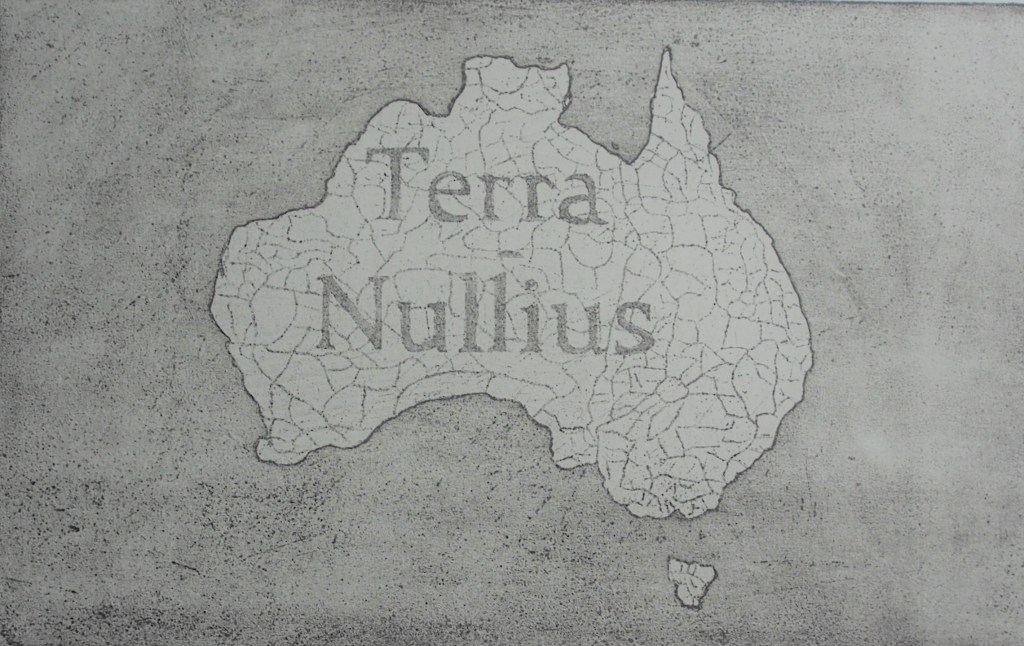
This year’s 250th anniversary of the mapping of the east coast of Australia by Lieutenant James Cook demands artistic responses which interrogate that visit and what ensued from it. Within two decades, the continent was invaded and colonised. Over the next two centuries, a continent nourished for more than 60,000 years by its diverse Indigenous nations was irreparably changed. This year offers an opportunity to acknowledge the consequences including the suppression of language and culture, the oppression and murder of many of its original peoples and major environmental degradation. We must recognise these traumatic elements of our history alongside our celebration of the many achievements of Australia.
As a non Indigenous Australian, I cannot present the experience of Aboriginal and Torres Strait Islander Australians but I can offer my personal response to our shared past and present. My views have been informed by listening to Indigenous and settler testimony and travelling to most parts of Australia. And I am very aware that, along with all other non Indigenous Australians, I have benefited from the expropriation and exploitation of the land. Those processes created national wealth at the cost of enormous suffering and continuing deprivation and intergenerational trauma.
Inspired by Thirty-six Views of Mount Fuji, Katsushika Hokusai’s extraordinary series of woodblocks from the 1830s, these twenty six etchings and aquatints attempt to engage with Australia’s complex post colonial history. Uluru symbolises the spirit of the land and is so recognised by most Australians but it is always sacred to Anangu. As is Fuji in Hokusai’s series, Uluru in these prints is sometimes distant, sometimes very present.
The moving and powerful Statement from the Heart was proclaimed at the First Nations National Constitutional Convention at Uluru on 26 May 2017 while this series was in development, reinforcing the importance of truth as a key element of the statement’s call for Voice Treaty Truth. Informed by three subsequent visits to Uluru, the series attempts to contribute to truth-telling by depicting elements of our shared history including some that many find traumatic.
The 26 etchings and aquatints were created with a modified version of the less toxic saline sulphate etch first suggested by Nik Semenoff (Salt Etch, Leonardo, 1998) and Cedric Green (The Bordeaux Etch) which employs a salt & copper sulphate mordant on aluminium plate. Each was printed on Hahnemuhle 300 g paper in an edition of 10.
The prints are exhibited at Gaffa Gallery together with Death mask (ink jet printed papier mâché mask, 2019) and a number of Australian literary classics that have been ‘distressed’ by cutting into them and inserting pop-up elements and words from the Aboriginal language most closely associated with the region referred to in the book. These distressed books attempt to highlight the distress caused by the ‘whitewashing’ of Australian history and culture in our literary and historical canon until very recently. That canon continues to shape most non Indigenous Australians’ views about our history. I am grateful to Indigenous individuals and organisations that responded to my requests for advice on the appropriate use of language in these works.
 Alex Byrne Printmaker