
Barka was inspired by several trips along the great Darling River, seeing it bone dry, with water trickling down at last and with a good flow. Much of its course flows through the lands of the Pakaantji who called it the Barka and enjoyed its fish, mussels, yabbies and surrounding plants and animals. They traded with other peoples and met at ceremonial grounds including magnificent Mutawintji. The etchings and aquatints recognise their presence and ownership but avoid appropriating their imagery. I pay my respect to Paakantyi Elders, past and present and recognise their continuing ownership of that land.
Following exploratory visits by Sturt, Mitchell and others, settlers grabbed land and brought in their sheep and cattle. Paakantyi were driven off and subdued by massacres and the Native Police. The river became known as the Darling and became a highway for paddle steamers as port towns developed at Wentworth, Louth and Bourke. One of my great grandfathers, John Alfred Byrne, was the teacher at Louth in the 1890s when it was a prosperous entrepot for the wool growers along the river, far from the hamlet of today.
The etchings and aquatints present vignettes of this history. The camel trains and paddle steamers of colonialism are followed by the fish kills and goats of today. The striking Sturt Desert Pea reminds us of the blood shed as the frontier extended to the west and north.
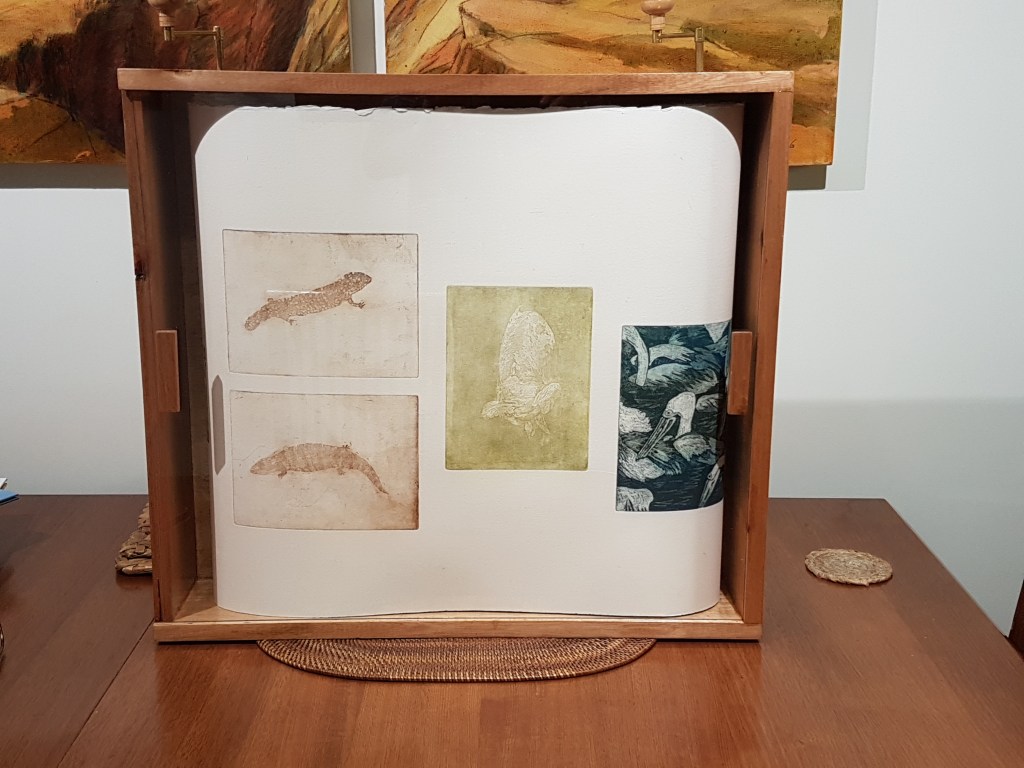
Tasmanian Oak Box with perspex window containing Velin Arches Blanc 300 gsm 9 metre x 535 mm roll of 37 Aquatints and Etchings of the Barka/Darling series on Hahnemuhle 300 gsm; dimensions 645x590x140.
Thirty seven aquatints and etchings are printed on a nine metre length of Velin Arches paper, recalling the charts or river maps used by the paddle steamer skippers on the Darling, Murray and Murrumbidgee, when they were mighty rivers. As with the originals, the paper is mounted on two rollers in a timber case so that it can be rolled from one to the other, revealing the prints one by one.
The full images with proper dimensions can be seen in a slideshow here and all of the images can be seen here.
An artists’ book of both the Barka and Apocalypse series, which includes images of the Barka works with brief descriptions of their inspiration, can be downloaded here. A handbound copy can be purchased in the Print Shop.
 Alex Byrne Printmaker