
Covered up: Australia’s literary whitewash
These works were inspired by the comment of a wealthy Sydney socialite that she ‘knew about Aborigines’ because she had read Coonardoo at school – sixty plus years previously! The comment crystallised for me an important source for the continuing wilful ignorance of Aboriginal and Torres Strait Islander peoples, languages and cultures among ‘mainstream’ Australians. These works attempt to release the indigenous elements hidden in and by our literary culture. The books are exhibited at Gaffa Gallery together with Death mask (ink jet printed papier mache moulded mask, 2019) and 26 Views of Uluru, a series of 26 etchings and aquatints interrogating our treatment of our Indigenous peoples since James Cook’s visit in 1770.
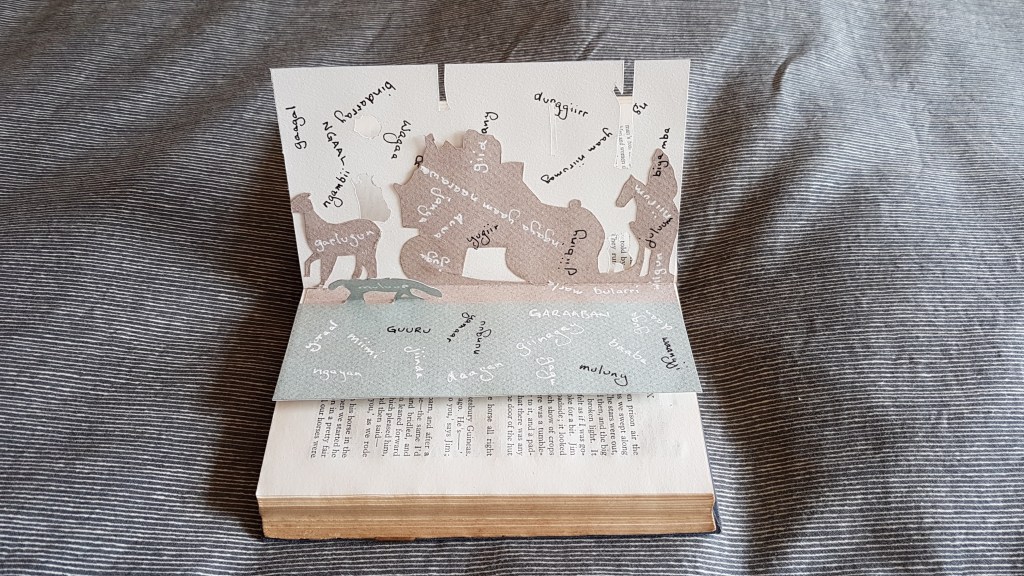
The works consist of ten ‘distressed books’, books that have been modified by cutting into the pages, inserting cut out elements and writing in words from the Indigenous language most relevant to the location in which each of the books is set, or the closest approximation when the location isn’t specified sufficiently.
The books were randomly selected from those available in a Sydney secondhand bookshop, augmented with a couple from my own collection and another bookshop. They are representative of the Australian voice that emerged from the late nineteenth to the mid twentieth centuries; novels, stories and poetry that presented Australian themes in Australian settings with Australian characters speaking in Australian accents. They were welcome replacements for the staple British fare and empire themes that predominated at that time and up to the 1960s. Many are still considered to be Australian classics.
But few featured or even mentioned the Indigenous owners of the areas in which they were set, nor featured Indigenous characters, voices or language. That overwhelming oblivion of Australia’s Indigenous past and present constituted a whitewash and supported the colonisers project to make a new ‘White Australia’ unsullied/untainted by recognition of prior peoples or rights.
My intent in inserting cutouts and Indigenous languages into the books is to restore the missing elements. The cutouts are imaginative interpretations of what might have been mentioned by the authors. The words are taken from publicly available glossaries and dictionaries of the Indigenous language most pertinent to the location of each of the books, as best I can determine. I have employed words for parts of the body or food, avoiding anything of a secret or sacred nature. My intention is to highlight this glaring deficiency in our national literary corpus, not to rewrite the books or give an Indigenous perspective on them.
 Alex Byrne Printmaker